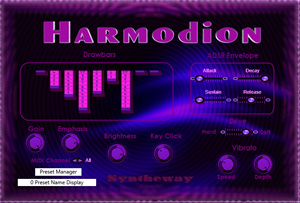
::: Harmodion is a Drawbar organ and a free reed aerophone instrument emulation, including Reed organ, Harmonium, Accordion and Bandoneon among others. Harmodion uses Additive Synthesis allowing to manipulate harmonically the sine waveform components to produce pitched sounds, as well as to individually detune those components to produce inharmonic timbres. ---- Harmodion is a Drawbar organ VST, Reed organ VST, Harmonium VST, Accordion VST, Bandoneón VST, Flutina VST and Harmonica VST emulation using Additive Synthesis, allowing to manipulate harmonically the sine waveform components to produce pitched sounds, as well as to individually detune those components to produce inharmonic timbres.= Drawbar VSTi free reed aerophone Reed organ VSTi, Harmonium VSTi, Accordion VSTi, Bandoneón VSTi, Bandonion VSTi, Harmonica VSTi, and Flutina VSTi.  ---- The Harmodion drawbars give the player control over the combination of fundamental and harmonic frequencies. Each drawbar represents a relative harmonic frequency (pitch). --- = Design, Optimization, DSP and GUI by Daniel Alberto Laiseca -------- Drawbars: - 16' 1 octave below fundamental - 5 1/3' a fifth above fundamental - 8' fundamental - 4' 1 octave above fundamental - 2 2/3' 1 octave and a fifth above fundamental - 2' 2 octaves above fundamental - 1 3/5' 2 octaves and a major third above fundamental - 1 1/3' 2 octaves and a fifth above fundamental - 1' 3 octaves above fundamental ---- The Telharmonium (also known as the Dynamophone) was an early electronic musical instrument, developed by Thaddeus Cahill in 1897. The electrical signal from the Telharmonium was transmitted over wires; it was heard on the receiving end by means of 'horn' speakers. Like the later Hammond organ, the Telharmonium used tonewheels to generate musical sounds as electrical signals by additive synthesis. = = = Harmonium, Indian Harmonium, Coupler, Double Reed Harmonium, Triple Reed Harmonium, 3 reed Harmonium, Double Below Harmonium= = -: - -:All instruments & effects are VST 2.0 plug-ins. You need a PC to run them and a compatible host software -:      

Menu

»

Home

Harmodion VSTi

Harmodion MP3 demosStream: m3u playlist


..........::::::::: Listen MP3 Demo Song ::::::......... :: Screenshot - High Resolution :: ....:::::::Download FREE DEMO Version:::::::...........


Overview

Harmodion is a Drawbar organ and a free-reed aerophone instrument emulation, such as Reed organ, Harmonium, Accordion and Bandoneon among others.

Harmodion uses Additive Synthesis allowing to manipulate harmonically the sine waveform components to produce pitched sounds, as well as to individually detune those components to produce inharmonic timbres.

::::: Designed for Windows 98 / Me / 2000 / XP ::::::.  ......::::::: Linux Operating System - See Requirements .....::::::

Features

  • 9 Drawbars. By sliding drawbars in or out, the user can mix various pitches and create the richly distinctive sounds of an electric organ or of a free reed aerophone instrument.

  • The Additive synthesis constructs complex sounds by controlling the level of individual sine-wave components. The sound can be reshaped by alterations made to timbre. A harmonic sound could be restructured to sound inharmonic, and vice versa.

  • The rich harmonic content of their sound allows to generate the widest palette of tonal variations for Drawbar organs, Reed organs and Squeezeboxes emulations.

  • Vibrato effect, with depth and speed modulation controls.

  • Adjustable Key Click simulation to add the percussive effect for distinctive organ sounds and button click noise in Accordion and Bandoneon presets. 

  • Configurable Drive level. Accomplished by clipping the input signal, this effect adds sustain and additional harmonics and overtones to the signal, creating a richer sound with a warm thickness regarding to the original tone.

  • 32 Presets available for immediate use in a wide range of genres from blues, jazz, gospel and rock styles to folk, ethnic and popular music.

  • Full MIDI Automation: Complete MIDI Continuous Controller (Control of all parameters for use with external hardware control). The following 21 MIDI CC messages are recognized and affect the following parameters:

:: MIDI Implementation Chart for Harmodion::

Controller Number |Controller Name

CC# 00 - CHANNEL 
CC# 07 - VOLUME
CC# 11 - DRIVE (HARD / SOFT)

CC# 21 -DRAWBAR 1
CC# 22 -DRAWBAR 2
CC# 23 -DRAWBAR 3
CC# 24 -DRAWBAR 4
CC# 25 -DRAWBAR 5
CC# 26 -DRAWBAR 6
CC# 27 -DRAWBAR 7
CC# 28 -DRAWBAR 8
CC# 29 -DRAWBAR 9

CC# 70 - ADSR  - DECAY
CC# 71 - ADSR -  SUSTAIN
CC# 72 - ADSR - RELEASE
CC# 73 - ADSR - ATTACK
CC# 76 - ADSR - GAIN

CC# 74 - BRIGHT
CC# 75 - KEY CLICK NOISE

CC# 91 - VIBRATO - SPEED 
CC# 92 - VIBRATO - DEPTH


Listen more MP3 demo songs - If you are looking for a Virtual Bandoneon VST, Virtual Accordion VST, Virtual Harmodium VST, Virtual Reed Organ VST or Virtual Drawbar Organ VST, try the Harmodion VSTi software for free. ---- The Harmodion drawbars give the player control over the combination of fundamental and harmonic frequencies. Each drawbar represents a relative harmonic frequency (pitch).


List of 32 HARMODION Presets

- Default
- Drawbar Organ
- Orgue de la Chapelle
- Vibratone (Reed Aerophone) 
- Flute Organ
- Tan-Go (Tango Accordion)
- Fantasy Organ
- Squeeze Accordion
- Organphone
- Harmonica
- Overdrive Organ 
- Harmonium
- Reed Organ
- Calliope Circus Organ
- Soft Organ
- Percussive Organ
- Hard Overdrive Organ
- Odd Organ
- Accordion
- Hammondish B3
- Bandoneón
- Rock Organ
- Elektro-Orgel
- Pure Organ
- Blues Organ
- Dirty Organ
- Rotary Organ 
- Metalized Rock Organ
- Space Organ
- Telharmonium (Dynamophone)
- Flutina Accordion
- VibraphOrgan


::::: Syntheway RetroMagix Harpsichord Plug-in Listed At KVR Audio Plugin Resources ::::Thanks Ben !!!!::::....


About the real instruments


Harmodion - Virtual Drawbar Organ VSTi ------   The component waveform ratios are mixed by sliding drawbars mounted above the two keyboards, which operate like the faders on an audio mixing board. When a drawbar is incrementally pulled out, it increases the volume of its component waveform. When pushed all the way in, the specified component wave form becomes absent from the mix. The labelling of the drawbar is derived from the stop system in pipe organs where the physical length of the pipe corresponds to the pitch produced. Drawbars: - 16' 1 octave below fundamental - 5 1/3' a fifth above fundamental - 8' fundamental - 4' 1 octave above fundamental - 2 2/3' 1 octave and a fifth above fundamental - 2' 2 octaves above fundamental - 1 3/5' 2 octaves and a major third above fundamental - 1 1/3' 2 octaves and a fifth above fundamental - 1' 3 octaves above fundamental  ----  The Telharmonium (also known as the Dynamophone) was an early electronic musical instrument, developed by Thaddeus Cahill in 1897. The electrical signal from the Telharmonium was transmitted over wires; it was heard on the receiving end by means of 'horn' speakers. Like the later Hammond organ, the Telharmonium used tonewheels to generate musical sounds as electrical signals by additive synthesis.  - The Harmodion drawbars give the player control over the combination of fundamental and harmonic frequencies. Each drawbar represents a relative harmonic frequency (pitch). Drawbar Organ: The component waveform ratios are mixed by sliding drawbars mounted above the two keyboards, which operate like the faders on an audio mixing board. When a drawbar is incrementally pulled out, it increases the volume of its component waveform. When pushed all the way in, the specified component wave form becomes absent from the mix. The labelling of the drawbar is derived from the stop system in pipe organs where the physical length of the pipe corresponds to the pitch produced. Hammond drawbars are set up in groups of nine arranged as follows: - 16' 1 octave below fundamental - 5 1/3' a fifth above fundamental - 8' fundamental - 4' 1 octave above fundamental - 2 2/3' 1 octave and a fifth above fundamental - 2' 2 octaves above fundamental - 1 3/5' 2 octaves and a major third above fundamental - 1 1/3' 2 octaves and a fifth above fundamental - 1' 3 octaves above fundamental. 


Harmodion - Virtual Reed Organ VSTi  --------    A reed organ, also called parlor organ, pump organ, cabinet organ, cottage organ, is an organ that generates its sounds using free metal reeds. Smaller, cheaper and more portable than pipe organs, reed organs were widely used in smaller churches and in private homes in the 19th century, but their volume and tonal range are limited, and they were generally confined to one or two manuals, with pedalboards being extremely rare. Reed Organ: A reed organ, also called parlor organ, pump organ, cabinet organ, cottage organ, is an organ that generates its sounds using free metal reeds. Smaller, cheaper and more portable than pipe organs, reed organs were widely used in smaller churches and in private homes in the 19th century, but their volume and tonal range are limited, and they were generally confined to one or two manuals, with pedalboards being extremely rare.


Harmodion - Virtual Harmonium VSTi  --------------  A harmonium is a free-standing keyboard instrument similar to a reed organ. Sound is produced by air, supplied by foot-operated or hand-operated bellows, being blown through sets of free reeds, resulting in a sound similar to that of an accordion. Harmonium: A harmonium is a free-standing keyboard instrument similar to a reed organ. Sound is produced by air, supplied by foot-operated or hand-operated bellows, being blown through sets of free reeds, resulting in a sound similar to that of an accordion.


Harmodion -  Virtual Bandoneon VSTi  -------------- The bandoneón is a type of concertina particularly popular in Argentina. It plays an essential role in the orquesta tipica, the tango orchestra. The bandoneón, called bandonion by its German inventor, Heinrich Band (1821–1860), was originally intended as an instrument for religious music and the popular music of the day, in contrast to its predecessor, the German concertina (or Konzertina), considered to be a folk instrument by some modern authors. German sailors and Italian season workers and emigrants brought the instrument with them to Argentina in the late nineteenth century, where it was incorporated into the local music, such as tango. Bandoneon: The bandoneón is a type of concertina particularly popular in Argentina. It plays an essential role in the orquesta tipica, the tango orchestra. The bandoneón, called bandonion by its German inventor, Heinrich Band (1821–1860), was originally intended as an instrument for religious music and the popular music of the day, in contrast to its predecessor, the German concertina (or Konzertina), considered to be a folk instrument by some modern authors. German sailors and Italian season workers and emigrants brought the instrument with them to Argentina in the late nineteenth century, where it was incorporated into the local music, such as tango.


Harmodion -  Virtual Accordion VSTi   -------------- The accordion is a box-shaped musical instrument of the bellows-driven free-reed aerophone family, sometimes referred to as a squeezebox. A person who plays the accordion is called an accordionist. It is played by compressing or expanding a bellows whilst pressing buttons or keys, causing valves, called pallets, to open, which allow air to flow across strips of brass or steel, called reeds, that vibrate to produce sound inside the body Accordion: The accordion is a box-shaped musical instrument of the bellows-driven free-reed aerophone family, sometimes referred to as a squeezebox. A person who plays the accordion is called an accordionist. It is played by compressing or expanding a bellows whilst pressing buttons or keys, causing valves, called pallets, to open, which allow air to flow across strips of brass or steel, called reeds, that vibrate to produce sound inside the body.


Harmodion -  Virtual Flutina VSTi  ---------- The flutina is an early precursor to the diatonic button accordion, having one or two rows of treble buttons, which are configured to have the tonic of the scale, on the "draw" of the bellows. There is usually no bass keyboard: the left hand operates an air valve (silent except for the rush of air). A rocker switch, called a "bascule d'harmonie" is in the front of the keyboard. When this switch is thumb activated, it would open up a pallet (a pad that covers a tone hole, at the other end of the key button(s), (see photo) for a simple Tonic/Dominant drone: Tonic on the draw and Dominant on the press, e.g. Tonic notes C/g, and Dominant G/d, without any major or minor thirds. Flutina: The flutina is an early precursor to the diatonic button accordion, having one or two rows of treble buttons, which are configured to have the tonic of the scale, on the "draw" of the bellows. There is usually no bass keyboard: the left hand operates an air valve (silent except for the rush of air). A rocker switch, called a "bascule d'harmonie" is in the front of the keyboard. When this switch is thumb activated, it would open up a pallet (a pad that covers a tone hole, at the other end of the key button(s), (see photo) for a simple Tonic/Dominant drone: Tonic on the draw and Dominant on the press, e.g. Tonic notes C/g, and Dominant G/d, without any major or minor thirds.


Harmodion -  Virtual Harmonica VSTi  --------- The harmonica, also called harp, French harp, Blues harp, and mouth organ,[1] is a free reed wind instrument used primarily in blues and American folk music, jazz, country music, and rock and roll. It is played by blowing air into it or drawing air out by placing lips over individual holes (reed chambers) or multiple holes. The pressure caused by blowing or drawing air into the reed chambers causes a reed or multiple reeds to vibrate up and down creating sound. Each chamber has multiple, variable-tuned brass or bronze reeds, which are secured at one end and loose on the other end, with the loose end vibrating and creating sound. Harmonica: The harmonica, also called harp, French harp, Blues harp, and mouth organ, is a free reed wind instrument used primarily in blues and American folk music, jazz, country music, and rock and roll. It is played by blowing air into it or drawing air out by placing lips over individual holes (reed chambers) or multiple holes. The pressure caused by blowing or drawing air into the reed chambers causes a reed or multiple reeds to vibrate up and down creating sound. Each chamber has multiple, variable-tuned brass or bronze reeds, which are secured at one end and loose on the other end, with the loose end vibrating and creating sound.


System Requirements

      Before you install VST Instruments & Effects, please make sure your computer fulfills the following requirements:

  • Operating System : Windows® 98SE/ME, Windows® 2000, Windows® XP, Windows® Vista, Windows® 7.

  • Linux Operating System, with the following requirements (Special Thanks to Paul Davis)

  • Processor: Pentium®, Celeron® or equivalent - 500 MHz or more (recommended).

  • RAM: 64 MB of memory minimum (128 MB or higher recommended)

  • VST plug-ins can be "plugged in" to any host application that supports them allowing the same VST plug-in to be used with many different audio programs. In example host applications VST 2.0, 2.3 like: FL Studio 9.xx, Steinberg Cubase 5.xx - 4.xx, Synapse Audio Orion  7.xx, Sony Acid Pro 7.xx - 6.xx,  MakeMusic Finale 2010 v.15 -  2009 v.14, Mackie Tracktion 3.xx, Cockos Reaper 3.xx, Audio Mulch 2.xx, Steinberg Nuendo 4.xx - 3.xx, Magix Samplitude 11.xx - 10.xx, Cakewalk SONAR 8 (Producer Edition and Studio Edition), SONAR Home Studio 7, Magix Music Maker 15.xx, M-Audio Ableton Live 8.xx, 7.xx, M-Audio Evolution Sound Studio II  Standard & Pro 2.xx, PowerTracks Pro Audio, Making Waves Studio 5.xx, n-Track Studio 6 and more ...

  • Graphics (minimum): 16-bit 800x600

  • ToneWise's DirectiXer 2 VST adapter for DirectX host applications. The program wraps VST plugins so that they can be used in DirectX host applications, such as Cakewalk SONAR, Sonic Foundry Vegas, Syntrillium CoolEdit and many others. DirectiXer fully supports VST 2.0 instruments, exposing them as DXi instruments, and parameter automation recording and playback (host support is required).

  • Via FXpansion's VST-to-RTAS Adapter: Converts VST plug-ins to Digidesign RTAS format for use in Pro Tools HD, LE, and M-Powered.

  • Via FXpansion's VST to AudioUnit Adapter for Mac OS X: Converts VST plug-ins to Apple Audio Units for use in AU-compatible applications including Logic Pro, Garage Band and Digital Performer.  

  • Other Components: PC configured according to the specifications of the host application

  • An ASIO® soundcard is recommended for low latency real-time play.

  • Please test extensively the demo version of your selected product (s) in your host to make sure there are no misbehaviors before purchasing.


Installation

    To install VST plug-in, follow these steps: 

  • The file must be in a directory where the VST host is looking for VST plug-ins. 

  • Unzip the file.

  • Put the Harmodion demo.dll file into VST Plug-ins Folder of your host application.


    To uninstall simply remove the .dll file of your VST Plug-ins folder.


Version History

  • v1.0: First release.

  • v.0.9, v0.95, v0.97: Beta (Beta Tester version only)

Plug-in Credits

Design, optimization, DSP and GUI  by Daniel Alberto Laiseca

Evaluation & Registration

The DEMO VERSION is full functional. You can do anything you can do with the full version, you can even save your presets. Also in the demo are some presets included to demonstrate the instruments capabilities. The only restriction: 

The Demo generates a short beep in all output channels every 10 seconds.  
THE REGISTERED VERSION DOES NOT HAVE THIS INTERMITTING NOISE.

The program is a SHAREWARE. You are hereby licensed to use this software for evaluation purposes without charge for a period of 30 days. If you use this software after the 30 day evaluation period a registration fee is required. 

The full version is available to purchase, as downloadable software, the price is US$34,90, and you can download the full version as soon as your payment is received.

Make payments with PayPal - it's fast, free and secure!

PayPal (www.paypal.com), the Internet's leading payment network


PayPal allows anyone to send and receive money instantly through a secure method of online payment.

Make payments with PayPal - it's fast, free and secure!


Demo: Crystal Teardrops, from Castlevania Symphony Of The Night -Video Game- (a.k.a. Dracula X: Nocturne in the Moonlight OST). VST instruments used: Aeternus Brass, Syntheway Strings, Realistic Virtual Piano, Harmodion (outro) and Magnus Choir(outro). 


VST is a trademark of Steinberg Soft- und Hardware GmbH. - Virtual Bandoneon VST, Virtual Accordion VT, Virtual Hamonium VST, Virtual Drawbar Organ VST, Virtual Reed Organ VST -  Drawbars: - 16' 1 octave below fundamental - 5 1/3' a fifth above fundamental - 8' fundamental - 4' 1 octave above fundamental - 2 2/3' 1 octave and a fifth above fundamental - 2' 2 octaves above fundamental - 1 3/5' 2 octaves and a major third above fundamental - 1 1/3' 2 octaves and a fifth above fundamental - 1' 3 octaves above fundamental  -- The Telharmonium (also known as the Dynamophone) was an early electronic musical instrument, developed by Thaddeus Cahill in 1897. The electrical signal from the Telharmonium was transmitted over wires; it was heard on the receiving end by means of 'horn' speakers. Like the later Hammond organ, the Telharmonium used tonewheels to generate musical sounds as electrical signals by additive synthesis. - The Harmodion drawbars give the player control over the combination of fundamental and harmonic frequencies. Each drawbar represents a relative harmonic frequency (pitch). - Drawbar Organ: The component waveform ratios are mixed by sliding drawbars mounted above the two keyboards, which operate like the faders on an audio mixing board. When a drawbar is incrementally pulled out, it increases the volume of its component waveform. When pushed all the way in, the specified component wave form becomes absent from the mix. The labelling of the drawbar is derived from the stop system in pipe organs where the physical length of the pipe corresponds to the pitch produced. Hammond drawbars are set up in groups of nine arranged as follows: - 16' 1 octave below fundamental - 5 1/3' a fifth above fundamental - 8' fundamental - 4' 1 octave above fundamental - 2 2/3' 1 octave and a fifth above fundamental - 2' 2 octaves above fundamental - 1 3/5' 2 octaves and a major third above fundamental - 1 1/3' 2 octaves and a fifth above fundamental - 1' 3 octaves above fundamental.

VST is a trademark of Steinberg Soft- und Hardware GmbH


Syntheway Virtual Musical Instruments © 2004-2010 Daniel Alberto Laiseca| Buenos Aires - Argentina|

Privacy Policy | Disclaimer | FAQ | Site Map Artists & BandsTechnical Support ContactAbout Us