::: MASTER HAMMOND is a Virtual B3 organ plug-in in VST format with a rich and authentic sound based on the legendary B3. The version 2.2 update features: - Added the following modes: * Jazz B3 (Slow) * B3 High Slow/Fast * B3 Low Slow * Overdrive (Distortion) Slow - Some GUI modifications (including embedded CHM Help/Info and direct link to website). - Some bug-fixes and smaller improvements. ::::::::::::: Features: Several samples are combined with a Sample Playback and DSP engine, based on the legendary B3. The result is a warm and powerful sound over the entire range of the keyboard. -- Improvements and Changes in v2.2: - Added the following modes: * Jazz B3 (Slow) * B3 High Slow/Fast * B3 Low Slow * Overdrive (Distortion) Slow - Some GUI modifications (including embedded CHM Help/Info in " blue icon and direct link to website in Syntheway's logo). Some bug-fixes and smaller improvements. Leslie Rotary Speaker Cabinet emulation effects are included in Slow/Fast; Bright/Dark modes. The original Hammond Organ was Designed and built by the ex-watchmaker Laurens Hammond in April 1935. Hammond set up his 'Hammond Organ Company' in Evanston, Illinois to produce electronic organs for the 'leisure market' and in doing so created one of the most popular and enduring electronic instruments ever built. Hammonds machine was designed using technology that relates directly to Cahill's 'Telharmonium' of 1900, but, on a much smaller scale. The Hammond organ generated sounds in the same way as the Telaharmonium, the tone weel-The tone generator assembly consisted of an AC synchronous motor connected to a geartrain which drove a series of tone wheels, each of which rotated adjacent to a magnet and coil assembly. The number of bumps on each wheel in combination with the rotational speed determined the pitch produced by a particular tone wheel assembly. The pitches approximate even-tempered tuning. The Hammond had a unique drawbar system of additive timbre synthesis (again a development of the Telharmonium) and stable intonation - a perennial problem with electronic instruments of the time. A note on the organ consisted of the fundamental and a number of harmonics, or multiples of that frequency. In the Hammond organ, the fundamental and up to eight harmonics were available and were controlled by means of drawbars and preset keys or buttons. A Hammond console organ included two 61-key manuals; the lower, or Great, and upper, or Swell, and a pedal board consisting of 25 keys. The concert models had a 32-key pedalboard. Hammond also patented an electromechanical reverb device using the helical tortion of a coiled spring, widely copied in later electronic instruments. As well as being a succesful home entertainment instrument, The Hammond Organ became popular with Jazz, Blues and Rock musicians up until the late 1960's and was also used by 'serious' musicians such as Karheinz Stockhausen in "Mikrophonie II"

Menu

»

Home

Master Hammond B3 VSTi

Ytse JamClick On Icon To Stream m3u playlist

Perfect StrangersClick On Icon To Stream m3u playlist

Lazy -intro-Click On Icon To Stream m3u playlist

More MP3 demosStream: m3u playlist


:: Screenshot - High Resolution ::....:::::::Download FREE DEMO Version:::::::...........


Overview

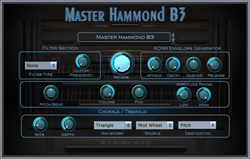
MASTER HAMMOND B3  is a Virtual Hammond VST plug-in  with a rich and authentic sound based on the legendary B3. The result is a warm and powerful sound over the entire range of the keyboard. The MHB3 is capable of all the variations one expects from this type of organ, and is suitable for any flavor of music, be it Rock, Jazz, Blues, Gospel, etc. (What's new in v2.21)

::::: Designed for Windows 98 / Me / 2000 / XP/ Vista Windows 7  ::::::. Recent Master Hammond B3 update to 2.2 features some improvements and minor adjustments: - Mode selector has been expanded with the following presets: * Jazz B3 (Slow) * B3 High Slow/Fast * B3 Low Slow * Overdrive (Distortion) Slow - Some GUI modifications (including embedded CHM Help/Info in "S" blue icon and direct link to website in Syntheway's logo).  - Some bug-fixes and smaller improvements.  ......::::::: Linux Operating System - See Requirements .....::::::

Features

  • B3 Mode Selector:
    • B3 Standard
    • Fast Bright
    • Slow Bright
    • Fast Dark
    • Slow Dark
    • Full Bright
    • 4 B3 Blues types
    • Jazz B3 (Slow)
    • B3 High Slow/Fast
    • B3 Low Slow 
    • Slow Overdrive (Distortion)
  • Authentic sound based on an intelligent VSTi engine and Sample Playback, which provides virtually unlimited dynamic expression for your performances. 

  • Modeled on mastered samples (normalized and noise-reduced). Based on PCM recordings of a Hammond B3 organ with full length sustain samples, no loops (natural decay), stored in 16 bits and 44.100 KHz.

  • The size has been significantly reduced. Great quality and reasonable small size: 13.7 MB (uncompressed).

  • Familiar, easy-to-use graphic user interface.

  • ADSR envelope generator with Attack, Sustain, Decay and Release parameters and several modulation targets.

  • Leslie Rotary Speaker Cabinet emulation is included in some presets with embedded effect.

  • Portamento/Glide control:  affects pitch transitions. A gliding effect that allows a sound to change pitch at a gradual rate, rather than abruptly, when a new key is pressed or MIDI note sent.

  • Reverb built-in: free variation of acoustic ambience thanks to complete separation of organ and room. Small rooms can be modeled just as accurately as larger spaces.

  • MIDI Automation: Added complete MIDI CC#. The following MIDI Continuous Controllers (MIDI CC) messages are recognized and affect the described parameters:

..........::::::::: Listen MP3 Demo Song ::::::.........

:: MIDI Implementation Chart for Master Hammond B3::
 

# Decimal   /     Controller Name 

CC# 05 - GLIDE - Portamento Time -
CC# 07 - MASTER VOLUME

CC# 71 - DECAY - ENVELOPE GENERATOR
CC# 72 - RELEASE - ENVELOPE GENERATOR
CC# 73 - ATTACK - ENVELOPE GENERATOR
CC# 74 - SUSTAIN - ENVELOPE GENERATOR

CC# 88 - REVERB SIZE ROOM
CC# 89 - REVERB WIDTH ROOM
CC# 90 - REVERB DAMPING FACTOR ROOM
CC# 91 - REVERB MIX LEVEL

http://www.kvraudio.com/news/4031.html

::::: Syntheway Plug-ins Listed At KVR Audio Plugin Resources ::::Thanks Ben !!!!::::.

More MP3 Demo SongsMaster Hammond B3 Demo Songs: 

Ytse JamClick On Icon To Stream m3u playlist    Perfect StrangersClick On Icon To Stream m3u playlist

Lazy intro (Overdrive/Dist. mode)Click On Icon To Stream m3u playlist    More MP3 demosStream: m3u playlist


System Requirements

      Before you install VST Instruments & Effects, please make sure your computer fulfills the following requirements:

  • Operating System : Windows® 98SE/ME, Windows® 2000, Windows® XP, Windows® Vista, Windows® 7.

  • Linux Operating System, with the following requirements (Special Thanks to Paul Davis)

  • Processor: Pentium®, Celeron® or equivalent - 500 MHz or more (recommended).

  • RAM: 64 MB of memory minimum (128 MB or higher recommended)

  • VST plug-ins can be "plugged in" to any host application that supports them allowing the same VST plug-in to be used with many different audio programs. In example host applications VST 2.0, 2.3 like: FL Studio 9.xx, Steinberg Cubase 5.xx - 4.xx, Synapse Audio Orion  7.xx, Sony Acid Pro 7.xx - 6.xx,  MakeMusic Finale 2010 v.15 -  2009 v.14, Mackie Tracktion 3.xx, Cockos Reaper 3.xx, Audio Mulch 2.xx, Steinberg Nuendo 4.xx - 3.xx, Magix Samplitude 11.xx - 10.xx, Cakewalk SONAR 8 (Producer Edition and Studio Edition), SONAR Home Studio 7, Magix Music Maker 15.xx, M-Audio Ableton Live 8.xx, 7.xx, M-Audio Evolution Sound Studio II  Standard & Pro 2.xx, PowerTracks Pro Audio, Making Waves Studio 5.xx, n-Track Studio 6 and more ...

  • Graphics (minimum): 16-bit 800x600

  • ToneWise's DirectiXer 2 VST adapter for DirectX host applications. The program wraps VST plugins so that they can be used in DirectX host applications, such as Cakewalk SONAR, Sonic Foundry Vegas, Syntrillium CoolEdit and many others. DirectiXer fully supports VST 2.0 instruments, exposing them as DXi instruments, and parameter automation recording and playback (host support is required).

  • Via FXpansion's VST-to-RTAS Adapter: Converts VST plug-ins to Digidesign RTAS format for use in Pro Tools HD, LE, and M-Powered.

  • Via FXpansion's VST to AudioUnit Adapter for Mac OS X: Converts VST plug-ins to Apple Audio Units for use in AU-compatible applications including Logic Pro, Garage Band and Digital Performer.  

  • Other Components: PC configured according to the specifications of the host application

  • An ASIO® soundcard is recommended for low latency real-time play.

  • Please test extensively the demo version of your selected product (s) in your host to make sure there are no misbehaviors before purchasing.


Installation

      To install VST plug-in, follow these steps: 

  • The file must be in a directory where the VST host is looking for VST plug-ins.

  • Unzip the file.

  • Put the Master Hammond B3 demo.dll file into VST Plug-ins Folder of your host application.

      To uninstall simply remove the Master Hammond B3 demo.dll file.


Version History

    • v2.2.1:
      - Fixed problem with stuck notes and velocity issues.
      - Other minor adjustments in presets sounds.

    • v2.2: Changes:
      - Added the following modes: Jazz B3 (Slow), B3 High Slow/Fast and B3 Low Slow Slow Overdrive (Distortion).
      - Some GUI modifications (including embedded CHM Help/Info and direct link to website).  
      - Some bug-fixes and smaller improvements.

    • v2.1: Changes:
      - Added Full Bright B3 Mode.
      - Added Portamento/Glide control.
      - Added MIDI Automation.
      - Some GUI modifications. 
      - Some bug-fixes and smaller improvements.

    • v2.0:  Improvements:
      - Improved sound engine.
      - Add ADSR envelope generator with Attack, Sustain, Decay and Release parameters and several modulation targets.
      - Sample playback optimized for better performance.
      - Patch selector improved
      - Redesigned GUI graphics
      - Updated built-in 4 patches Blues B3 Hammond Organ. 
      - Add Knobs (Volume and MIDI Channel Selector)
      Bug fix:
      - Some problems when used in Cubase SX fixed
      - Small bug fixes.

    • v1.0:  Initial version.

    • v1.0rc1:  Release Candidate.

    • v0.91/0.92:  Beta released.

    • v0.90: Alpha released. 


Plug-in Credits

Design, optimization, DSP and GUI  by Daniel Alberto Laiseca

Evaluation & Registration

The DEMO VERSION is full functional. You can do anything you can do with the full version, you can even save your presets. Also in the demo are some presets included to demonstrate the instruments capabilities. The only restriction: 

The Demo generates a short beep in all output channels every 10 seconds.  
THE REGISTERED VERSION DOES NOT HAVE THIS INTERMITTING NOISE.

The program is a SHAREWARE. You are hereby licensed to use this software for evaluation purposes without charge for a period of 30 days. If you use this software after the 30 day evaluation period a registration fee is required. 

The full version is available to purchase, as downloadable software, the price is US$35, and you can download the full version as soon as your payment is received.

Make payments with PayPal - it's fast, free and secure!

Paypal (www.paypal.com), the Internet's leading payment network


PayPal allows anyone to send and receive money instantly through a secure method of online payment.

Make payments with PayPal - it's fast, free and secure!


The Hammond organ, developed by Laurens Hammond and introduced in 1935, was the first commercially successful electric instrument. It was widely used in homes. It was also widely used in jazz, rock, and popular music performance, and it sparked the interest of George Gershwin, Ethel Smith, and other prominant musicians. ---- The original Hammond Organ was Designed and built by the ex-watchmaker Laurens Hammond in April 1935. Hammond set up his 'Hammond Organ Company' in Evanston, Illinois to produce electronic organs for the 'leisure market' and in doing so created one of the most popular and enduring electronic instruments ever built. Hammonds machine was designed using technology that relates directly to Cahill's 'Telharmonium' of 1900, but, on a much smaller scale. The Hammond organ generated sounds in the same way as the Telaharmonium, the tone weel-The tone generator assembly consisted of an AC synchronous motor connected to a geartrain which drove a series of tone wheels, each of which rotated adjacent to a magnet and coil assembly. The number of bumps on each wheel in combination with the rotational speed determined the pitch produced by a particular tone wheel assembly. The pitches approximate even-tempered tuning. The Hammond had a unique drawbar system of additive timbre synthesis (again a development of the Telharmonium) and stable intonation - a perennial problem with electronic instruments of the time. A note on the organ consisted of the fundamental and a number of harmonics, or multiples of that frequency. In the Hammond organ, the fundamental and up to eight harmonics were available and were controlled by means of drawbars and preset keys or buttons. A Hammond console organ included two 61-key manuals; the lower, or Great, and upper, or Swell, and a pedal board consisting of 25 keys. The concert models had a 32-key pedalboard. Hammond also patented an electromechanical reverb device using the helical tortion of a coiled spring, widely copied in later electronic instruments. As well as being a succesful home entertainment instrument, The Hammond Organ became popular with Jazz, Blues and Rock musicians up until the late 1960's and was also used by 'serious' musicians such as Karheinz Stockhausen in "Mikrophonie II"The Leslie Rotary Speaker Cabinet The Real Hammond & Leslie

The Hammond organ, developed by Laurens Hammond and introduced in 1935, was the first commercially successful electric instrument. It was widely used in homes. It was also widely used in jazz, rock, blues, gospel and popular music performance.  Perhaps the success of the Hammond B3 would not be without the trusty Leslie Speaker Cabinet. Invented by Don Leslie, create a speaker cabinet that spins, or spins the speakers to provide a very non directional sound that when coupled with the B3, sounds very much like a church organ, without all of the messy tubing.


Related Links - Master Hammond B3 Headlines

http://www.kvraudio.com/get/2012.html

http://www.kvraudio.com/news/4254.html

http://www.harmony-central.com/Newp/2005/Master-Hammond-B3-21.html


Video


MP3 demosStream: m3u playlist


VST is a trademark of Steinberg Soft- und Hardware GmbH. -- -- The original Hammond Organ was Designed and built by the ex-watchmaker Laurens Hammond in April 1935. Hammond set up his 'Hammond Organ Company' in Evanston, Illinois to produce electronic organs for the 'leisure market' and in doing so created one of the most popular and enduring electronic instruments ever built. Hammonds machine was designed using technology that relates directly to Cahill's 'Telharmonium' of 1900, but, on a much smaller scale. The Hammond organ generated sounds in the same way as the Telaharmonium, the tone weel-The tone generator assembly consisted of an AC synchronous motor connected to a geartrain which drove a series of tone wheels, each of which rotated adjacent to a magnet and coil assembly. The number of bumps on each wheel in combination with the rotational speed determined the pitch produced by a particular tone wheel assembly. The pitches approximate even-tempered tuning. The Hammond had a unique drawbar system of additive timbre synthesis (again a development of the Telharmonium) and stable intonation - a perennial problem with electronic instruments of the time. A note on the organ consisted of the fundamental and a number of harmonics, or multiples of that frequency. In the Hammond organ, the fundamental and up to eight harmonics were available and were controlled by means of drawbars and preset keys or buttons. A Hammond console organ included two 61-key manuals; the lower, or Great, and upper, or Swell, and a pedal board consisting of 25 keys. The concert models had a 32-key pedalboard. Hammond also patented an electromechanical reverb device using the helical tortion of a coiled spring, widely copied in later electronic instruments. As well as being a succesful home entertainment instrument, The Hammond Organ became popular with Jazz, Blues and Rock musicians up until the late 1960's and was also used by 'serious' musicians such as Karheinz Stockhausen in "Mikrophonie II"

VST is a trademark of Steinberg Soft- und Hardware GmbH


Hammond™ and Leslie™ are registered trademarks of Hammond Suzuki USA, Inc.


Syntheway Virtual Musical Instruments © 2004-2010 Daniel Alberto Laiseca| Buenos Aires - Argentina|

Privacy Policy | Disclaimer | FAQ | Site Map Artists & BandsTechnical Support ContactAbout Us