Release Notes: The latest release note is a terse
summary of recent changes, enhancements and bug
fixes in this particular software release.
Changes in
Windows v2.5:
• Added: VST3 Plugin format.
• Added: In 32 bit, panning potentiometer control to set the
panning of the instrument.
• Added: In 64 bit, MIDI CC automation. Implementation of
MIDI Continuous Controller parameters for use with external
hardware control via DAW: LFO depth (CC#1), expression
(CC#11), volume (CC#7), pan (CC#10), balance (CC#8), filter
cutoff (CC#74), ADSR (Attack: CC#73, Decay: CC#75, Sustain:
CC#76, Release: CC#72) and reverb depth (CC#91).
• Added: 32 and 64 bit, ADSR envelope generator.
Discontinued the unique release time control.
• Changed: In 32 bit, pitch bend control.
• Changed: In 32 bit, built-in reverberation.
• Changed: In 32 bit, low frequency oscillator with rate and
depth modulation parameters.
• Changed: In 32 bit, multimode filter by a filter section
with filter type box for low pass filter and high pass
filter.
• Changed: In 32 bit, predefined presets are accessed
exclusively and quickly from a new combo box.
• Changed: In 32 bit, MIDI CC automation. New implementation
of MIDI Continuous Controller parameters for use with
external hardware control via DAW: LFO depth (CC#1),
expression (CC#11), volume (CC#7), pan (CC#10), balance
(CC#8), filter cutoff (CC#74), ADSR (Attack: CC#73, Decay:
CC#75, Sustain: CC#76, Release: CC#72) and reverb depth
(CC#91).
• Changed: Renewed graphical user interface.
• Changed: User Guide updated to fit current version and
unified for Windows and macOS.
• Fixed: Minor bug fixed.
________________________________________
Changes in macOS v3.5:
• Added: VST3 Plugin format.
• Added: MIDI CC automation. Implementation of MIDI
Continuous Controller parameters for use with external
hardware control via DAW: LFO depth (CC#1), expression
(CC#11), volume (CC#7), pan (CC#10), balance (CC#8), filter
cutoff (CC#74), ADSR (Attack: CC#73, Decay: CC#75, Sustain:
CC#76, Release: CC#72) and reverb depth (CC#91).
• Added: ADSR envelope generator. Discontinued the unique
release time control.
• Changed: Renewed graphical user interface.
• Changed: User Guide updated to fit current version and
unified for Windows and macOS.
• Fixed: Minor bug fixed.
#
List of Preset Sounds
1
Concert Harp
2
Celtic Harp
3
Electric Harp
4
Synth Harp
5
Harp Glissando 01 Two
Handed
6
Harp Glissando 02 Two
Handed
7
Harp Glissando 03 Sweeping
8
Harp Glissando 04 Swirling
9
Harp Glissando 05 Upward
10
Harp Glissando 06 Downward
11
Harp Glissando 07 Up-Down
1
12
Harp Glissando 08 Up-Down
2
13
Harp Glissando 09 Up-Down
3
14
Harp Glissando 10 Ripples
15
Harp Glissando 11 Cascade
16
Harp Glissando 12
Waterfall
17
Harp Glissando 13 Arpeggio
18
Harp Glissando 14 Wavy Up
19
Harp Glissando 15 Resonant
20
Harp Glissando 16 Echoes
21
Harp Glissando 17 Slide Fx
22
Harp Glissando 18 Ending
Fx
23
Harp Glissando 19
Undulated
24
Harp Glissando 20
Miscellany
25
Harp Trill Slow to Fast
26
Harp Short Arpeggio
27
Harp Arpeggio Up-Down
28
Acoustic Hammered Dulcimer
29
Acoustic Hammered Dulcimer
Octaves
30
Acoustic Hammered Dulcimer
Glissando 1
31
Acoustic Hammered Dulcimer
Glissando 2
32
Electric Hammered Dulcimer
Presets Sounds Demo ↓
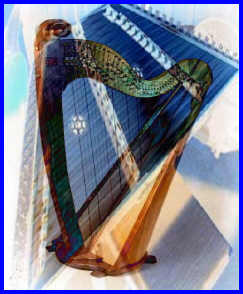
1.- Concert harp: Also known as 'Pedal Harp' is a large
and technically modern harp, designed primarily for
classical music and played either solo, as part of a chamber
ensemble, or in an orchestra.
2.- Celtic harp: The Celtic harp is a triangular harp
traditional to Brittany, Ireland, Scotland and Wales. It is
known as a telenn in Breton, cláirseach in Irish, clàrsach
in Scottish Gaelic and telyn in Welsh. In Ireland and
Scotland, it was a wire-strung instrument requiring great
skill and long practice to play, and was associated with the
Gaelic ruling class. It appears on the coins and coat of
arms of the Republic of Ireland.
3.-
Electric harp: Electric harps are based on their acoustic
originals. There are both solid-body and hollow body
electro-acoustic models available. True electric harps have
a solid body versus a hollow body electro-acoustic harp,
which can be played either acoustically or electronically. A
true electric solid-body harp cannot be played acoustically
since it has no hollow soundbox, and must be amplified when
played.
4.- Synth
Harp: a synthesizer harp with physically-modeled strings.
5.- Hammered dulcimer: most frequently but not
always trapezoidal in shape, with many strings struck by
handheld "hammers". This type of instrument is found in many
cultures, especially in England, in the British Isles and in
the north of continental Europe. Most countries have their
own name for the instrument, for instance in Thailand it is
called a khim, in India it is called Santoor and many have
different tuning systems. Being a struck string instrument,
it is considered to be among the ancestors of the piano.
6.- Electric Hammered Dulcimer: They come in a number of
different sizes, styles and types, and use a
pickup to amplify the sound.