|
1) Fender Rhodes Mark I™
(1969-1975)
The Fender Rhod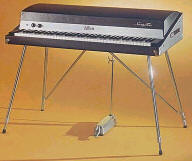 es
product line evolved quickly as the 1970's began. The
73-key Electric Piano was renamed the Fender Rhodes
Suitcase Piano in 1969, featuring a black harp cover
and a stereo 80W amp, and by 1970 the Fender Rhodes
Mark I Stage Piano was available. The Stage Piano
was the piano top from the Suitcase model, modified for
use with an external guitar or bass amplifier. The Stage
model featured detachable legs (parts from a Fender
pedal steel guitar), a sustain pedal and pushrod (part
of a Rogers hi-hat stand), and a simplified front panel
with only volume and bass EQ controls. Internally, the
Stage Piano was nearly identical to the Suitcase
model. Over the last few decades, the electric piano has
played a central role in music of all types, from
jazz/fusion and funk, to rock and dance. The Rhodes was
used much in jazz-fusion throughout the 1970s. Chick
Corea's album Light as a Feather and Miles Davis's In a
Silent Way featured the Rhodes throughout the whole
album. Joe Zawinul of Weather Report, Jan Hammer of the
Mahavishnu Orchestra and Herbie Hancock also used the
Rhodes. 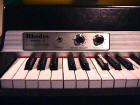
Classic Rhodes™
Effects
The piano's
clean tone is what you hear on many essential Fender
Rhodes recordings, but definitely not all of them. The
Rhodes sounds even better with the right amp and
effects. The Suitcase Vibrato was the original
Rhodes effect, built into all versions of the Suitcase
piano (as well as Stage models with the Super
Satellite & Janus I
systems). The idea behind the Vibrato was to simulate a
rotating speaker, although the actual sound was quite
different. The first version of the Vibrato was in mono,
a tremolo effect that varied the amplitude of the
piano's output in a square-wave pattern. When the
Suitcase amps went stereo in 1969, this pattern was
translated into a panning effect. Front-panel controls
were provided for Speed and Intensity.
2) Hohner Clavinet D6™
(Image Copyright by Electronic Edge Vintage Keys )
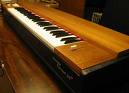 Musician
and inventor, Ernst Zacharias, designed the first of
these, the Cembalet, in the 1950’s. This was intended to
be a portable, amplifiable version of the Cembalo, or
Harpsichord. This worked by plucking the end of a flat
reed with the key, which was then picked up and
amplified in much the same way as an electric guitar. A
little later came the Pianet. Both the "CH" and "N"
models once again used flat reeds, but employed a very
different plucking/striking action. When a key was
depressed it engaged a "sticky pad" with foam backing
which actually stuck to the reed. When the key was
released, the pad came unstuck causing the reed to
vibrate which was then amplified. The Pianet model "T"
came much later and utilized the suction of a soft
rubber pad onto the reed. This was somewhat superior to
the "N" and "CH" models, but still had several
drawbacks. Although made very popular by bands such as
the Zombies and Small Faces, there wasn’t much dynamism
available from the keyboard. As all the reeds were
damped upon release, this negated the possibility of
obtaining sustain via a foot pedal.
The D6 was later superseded by the model E6 and the
Clavinet/Pianet Duo. These were basically the same, but
more roadworthy and better protected against proximity
hums and generally quieter than previous models.
However, these models came just a bit too late on the
scene in the age of electronics to be as successful as
they deserved to be.
3) Wurlitzer™
Electric Piano
Inventor Benjamin Miessner had designed an amplified
conventional upright piano in the 1930s, and Wurlitzer
used his electrostatic pickup design, but replaced the
strings with struck steel reeds. The instrument entered
production in 1955 as the EP-112 and continued to be
produced in various forms until about 1982 when
production of the EP-200A ceased.
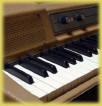
The Wurlitzer piano is usually a 64-note instrument
whose keyboard range is from A an octave above the
lowest note of a standard 88-note piano to the C an
octave below the top note of an 88-note piano. Tone
production in all models comprises a single steel reed
for each key, activated by a miniature version of a
conventional grand piano action and forming part of an
electrostatic pickup system using a DC voltage of 170v.
A mechanical sustain pedal similar to that of a
conventional piano is fitted
Compared with its erstwhile rival, the (Fender) Rhodes
electric piano, the Wurlitzer has a brighter, more
hollow sound. When played gently the sound can be quite
sweet and vibraphone-like, becoming more aggressive with
harder playing. In a pop or rock band setting with
guitar(s), bass and drums the Wurlitzer has a
distinctive and clear sound where a Rhodes would tend to
blend in. However it has also been used successfully in
MOR ballads and even country music.
4) Yamaha CP70™
Electric Grand
The quest for a portable piano has been around since the
invention of the Fender Rhodes and the Wurlitzer. Of
course, neither of these actually sound like pianos...
they have a pleasant sound that is 'piano-like' but in
no way are they a substitute for the real thing.
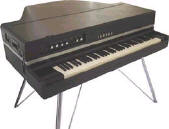
Several companies tried all sorts of things (including
some fairly horrible electronic things) but it wasn't
until Yamaha released their CP70 'Electric Grand Piano'
in the mid-'70s that I had something approaching a
'real' piano that could be toured around and amplified
easily without any difficult mic techniques.
There were three models in the product's lifetime... the
original CP70 (73-note keyboard) which was superceded by
the CP70B (with balanced outputs) and the CP80 (a full
88-note keyboard version).
|