Virtual Trombone VST, VST3, Audio Unit, EXS24, KONTAKT: Seventy-Six Trombones (The Music Man, Meredith Willson) Trombone Concerto in B-Flat Major, I. Allegro Vivace (Nikolai Rimsky-Korsakov)
VST, VST3 and Audio
Unit Plugins. EXS24 and KONTAKT Sample Libraries for Windows
and Mac
Seventy-Six Trombones (The Music Man,
Meredith Willson)
Aeternus
is a Virtual Brass instrument,
featuring solo Trumpet, Cornet, Trombone, Tuba, French Horn, Flugelhorn
as well as Brass Sections and Orchestral Ensemble.
Trombone Concerto in B-Flat Major, I.
Allegro Vivace (Nikolai Rimsky-Korsakov)
Overview
Aeternus
Brass
is a virtual musical ensemble and solo
trumpet, trombone, tuba, French horn, flugelhorn
and cornet instruments. It includes brass sections, orchestral ensemble and
sampled legato and staccato articulations. Additionally introduces four analog
brasses, based on classic polyphonic synthesizers. Available in VST 32 bit and 64 bit
and VST3 64 bit
versions for Windows / Audio
Unit, VST and VST3 for
macOS.
Features
• Quick selector to switch between different preset sounds:
#
List of Preset Sounds
1
Brass Section Ensemble 1
2
Brass Section Ensemble 2
3
Brass Section Ensemble 3
4
Brass Section Ensemble 4
5
Orchestral Brass Ensemble
6
Brass Ensemble Staccato
7
Brass Hit / Stab / Fall
Effects
8
Trumpet Legato
9
Trumpet Staccato
10
Trumpet Bubble Harmon Mute
11
Trombone Legato
12
Trombone Staccato
13
Tuba Legato
14
Tuba Staccato
15
French Horn Legato
16
French Horn Staccato
17
French Horns Section
18
Flugelhorn Legato
19
Cornet Legato
20
Synth Brass
21
Mellotron M400 GC3 Brass
22
Roland SC-88 Velo Brass
23
Oberheim Xpander Brass
24
Memorymoog Brass
Presets Sounds Demo ↓
•
Wider Spatial Auralization: The brass sections
ensembles and synthesized brass brings a stereophonic
widening sound to increase the
audible perspective or perceived breadth, even without using the built-in
reverberation.
•
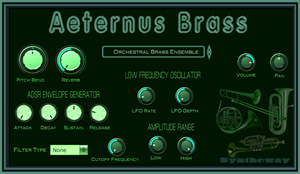
ADSR envelope generator with Attack, Sustain, Decay and Release parameters:
Ø Attack
determines the time it takes for the note to get to the maximum level.
Ø Decay
determines the time it takes for the note to go from the maximum level
to the sustain level (controlled by Sustain).
Ø Sustain
determines the level of the sound is played at while the note is held (after
the other envelope states, Attack and Decay, have been completed).
Ø Release
determines the time it takes for the note to fall from the sustain level
to zero (silence) level when it is released.
• Pitch Bend: The Pitch Bend knob directly changes the pitch of the selected
instrument.
Ø Pitch
Bend center position: is normal pitch.
Ø Pitch
Bend down: Specifies the amount of pitch change that will occur when the
pitch bend/modulation lever is moved to the left.
Ø Pitch
Bend up: Specifies the amount of pitch change that will occur when the
pitch bend/modulation lever is moved the right.
• Low-Frequency Oscillator Controls: These knobs apply LFO modulation to the
selected instrument. By using the LFO to modulate various aspects of the
audio signal, you can apply effects such as vibrato or tremolo.
Ø LFO
Rate: This knob controls the frequency. Turn clockwise for a faster
modulation rate. Ø LFO
Depth: This knob controls the amplitude. With a lower setting, the
resulting modulation is subtle, while a higher depth will result in a
much more extreme effect.
• Reverb Room built-in: provides a spaciousness and depth to simulate the
sound reflections from walls, floors and ceilings following a sound created
in an acoustically reflective environment. Small rooms can be modeled as
well as large spaces.
• Filter Type. Combo box to switch between the following options:
Ø Low
Pass (LPF): a filter that passes signals with a frequency lower than a
certain cutoff frequency and attenuates signals with frequencies higher
than the cutoff frequency.
Ø High
Pass (HPF): a filter that passes signals with a frequency higher than a
certain cutoff frequency and attenuates signals with frequencies lower
than the cutoff frequency.
Ø None:
No filter is applied.
Ø Cutoff
Frequency Filter: Sets the cutoff frequency for the low pass and high
pass filters.
• Amplitude Range Parameters: It controls the loudness, the way in which we
perceive amplitude.The sensitivity level is set by the user:
• Panning potentiometer control: Set the panning of the instrument. Adjusts
the stereo pan position of the signal output, which determines how much of
signal is sent to the left and right channels.